America Magazine
The Jesuit Review
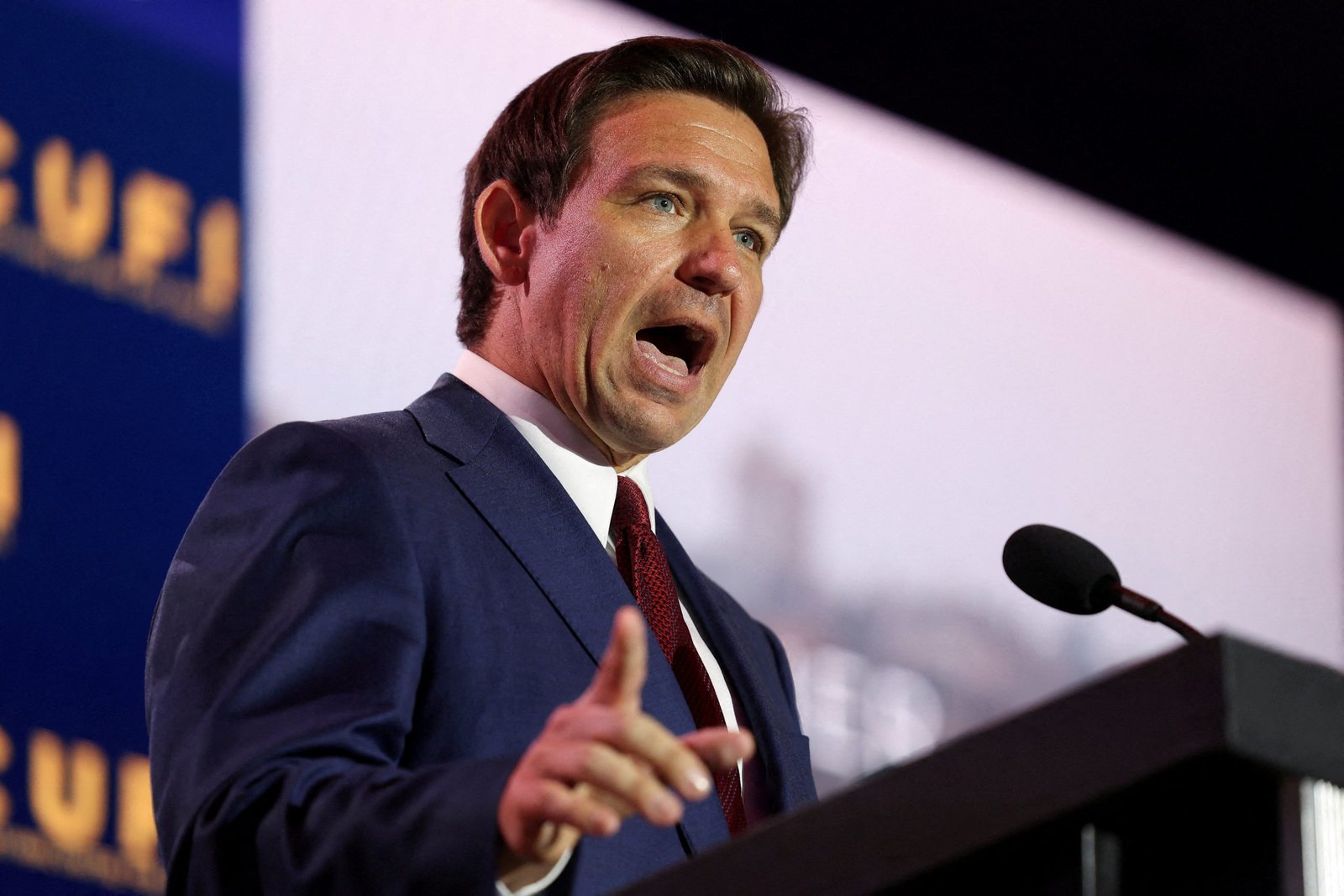
Gov. Ron DeSantis used a visit with the Florida Sheriffs Association Summer Conference to talk about his decision to proceed with a rare public spectacle—a double execution—on July 28.
“Part of being a free, vibrant society is that you have the freedom to live your life without having fear of the criminal element shattering your life, and so we’ve been very strong on this,” the governor said, speaking at Trump National Doral Resort in Miami. “I just presided today over two executions on the same day—first time that’s happened in a long time.” In fact, it was the first time in 62 years in Florida.
“I don’t take joy in doing that; it’s a weighty thing,” he quickly added. The governor explained to the sheriffs that the Covid-19 years had thrown the state “off its schedule.”
Now it seems the governor is eager to make up for lost time. The death penalty appeals process, he said, takes “way too long.” Accelerating executions, he has argued, will create a deterrent effect on capital crimes.
(The governor’s office declined a request from America to speak with the governor about the executions and his response to a pastoral letter condemning capital punishment from the Florida bishops issued the day before the executions.)
“Horrifying” was the assessment of the day’s events from Krisanne Vaillancourt Murphy, “the fact that we just had two executions in one day, the fact that [Florida] had 19 executions last year and we’ve got 25 percent more executions in Florida in 2026 already.” Ms. Vaillancourt Murphy is the executive director of the Catholic Mobilizing Network, a national advocacy group for the abolition of capital punishment that works in collaboration with the U.S. Conference of Catholic Bishops.
Gov. DeSantis has set a pace that will mean an execution will be occurring just about every two weeks, she said. “He seems to be relishing this ability to just at any moment sign any death warrant of anyone on Florida’s death row.”
“We can’t let this go unnoticed; this is not normal. This is not even normal in the death penalty world,” she said, noting Florida’s schedule far exceeds the rate set by Texas and Oklahoma, states that consistently account for high annual numbers of executions.
Both of the men executed on July 28 were elderly; the oldest, Dominick Occhicone, was 80 years old and in poor health. He became the second-oldest inmate to receive a lethal injection in modern U.S. history. Florida currently plans the executions of more elderly people than any other state. Local anti-death penalty advocates argue that the execution of the elderly violates the Eighth Amendment prohibition against cruel and unusual punishment.
Florida is creating a new juridical conundrum: The Supreme Court has already ruled that people convicted of capital crimes when they were younger than 18 are barred from execution, but can the convicted ever become too old to be executed?
For Miami Archbishop Thomas Wenski, the age issue ties in with the contemporary church’s reassessment of capital punishment, which began when St. John Paul II declared that it could never be justified in societies that had sufficient means to protect the public. Imprisoned for 30 years or more, the two men “weren’t a threat to anybody outside of prison,” Archbishop Wenski said, “so some might say, ‘Why execute them when nature will take its course sooner rather than later?’”
“I can’t explain the thinking other than that [Mr. DeSantis] wants to come across as a tough guy,” the archbishop said, noting that “there was a long stretch of time that he didn’t do any executions, then all of a sudden, he ramped them up.”
Archbishop Wenski wondered how much pure politics is at work in the governor’s renewed enthusiasm for the death penalty, noting that Mr. DeSantis cannot run for governor again and that a tough-on-crime image may give him “a leg up for a future presidential run.”
For his part, the governor has objected to the years, even decades, it takes to conclude death penalty cases as an offense to the families of homicide victims.
Such cases “shouldn’t be going for 20 years,” he said at the sheriff’s conference. “You should be able to try and maybe appeal, but then at some point we’ve got to get cracking here.”
“Some of the victims’ families had been waiting a long time,” he said, some asking, “‘When are we going to get justice?’… We do owe it to them to do it.”
“We’ve done that now. I think we’ll probably end up having done more [executions] than any administration in the history of the state of Florida, and I’m not…taking pride in that,” Mr. DeSantis said. “But to me, as we move through those [executions] and bring justice, that makes a big difference for a lot of people out there who suffered really, really serious tragedies.”
Ms. Vaillancourt Murphy wished that Mr. DeSantis, “a self-proclaimed Catholic,” might follow the lead of another Catholic governor, Mike DeWine of Ohio. A former prosecutor, Mr. DeWine in June denounced the use of the death penalty, acknowledging that his previous faith in capital punishment’s usefulness as a deterrence was not factually grounded.
She suggested that Mr. DeSantis review murder rates around the country. “It’s the states that don’t have the death penalty that have lower murder rates,” she said.
“At the very heart of all this is bringing about justice for victim families, [but] we know that the death penalty doesn’t provide that healing or closure,” she said. “People have waited 25, 30, 40 years and realized, ‘I was waiting for this? This is it?’ And realizing it doesn’t resolve any of [the trauma] that happens with loss like that.”
Archbishop Wenski agreed family members of murder victims are not going to find much “closure” in the execution of the people responsible for harming their loved ones. “Killing somebody doesn’t bring their loved ones back,” he said. It is an effort to show “that killing is bad by killing [an offender]. It’s not very coherent.”
And it puts the United States in unusual company as one of the few Western nations that still embraces capital punishment, he said. The United States was among the top five worldwide in executions in 2025, behind China, Iran, Saudi Arabia and Yemen.
The institution merely hardens hearts, Archbishop Wenski argued, perceiving a connection to a similar civic hardening regarding the treatment of undocumented and other immigrants.
Catholic teaching on the death penalty has experienced significant revisions in recent years, beginning with St. John Paul II and Pope Benedict XVI and concluding with its designation as “inadmissible” by Pope Francis in 2018 and a recasting of the catechism.
“It could not be more clear from all the bishops in his state, from the U.S. bishops’ conference, from the Vatican,” Ms. Vaillancourt Murphy said. “This is contrary to human dignity. It’s ‘inadmissible.’”
The bishops of Florida have long been vocal opponents of the death penalty, she said. The recent pastoral letter is a “really strong” extension of that commitment that suggests how extreme Florida’s willingness to execute prisoners has become.
Archbishop Wenski said Florida bishops delivered their letter directly to the governor’s office, but the conference, which urges clemency in each capital case, has not had much influence on Mr. DeSantis’s decisions. He acknowledged that the governor and Florida bishops have not had the best relationship. He has personally clashed over a funding issue for Catholic schools and the governor’s assertion that Catholic Charities Miami’s assistance for unaccompanied minors represented a collaboration with human-trafficking cartels.
The archbishop confirmed that on the issue of the death penalty, Catholic political leaders should be guided by the church’s “pretty clear teaching.” He hesitated, however, to say that politicians who are resolutely indifferent to that teaching should face the same sanctions, like the denial of Communion, sometimes applied to Catholic politicians who support abortion rights.
As bishops, “we want to make the road to heaven easier, not the other way around,” he said.
Despite the governor’s execution binge, public support for capital punishment continues to wane; Gallup reported in 2024 that it had declined to 53 percent, a five-decade low.
Ms. Vaillancourt Murphy believes that sentiment toward the abolition of the death penalty in the United States will continue. Florida has become an outlier, pushing national statistics up even as other states continue moratoriums or abolish the death penalty altogether.
Connecting the death penalty to other applications of state force, like its response to undocumented residents, she said, in contemporary Florida “we’re seeing some of the worst examples of how you address violence, how you respond to harm, how you really define justice.”
“Alternatively, I think that there have been really courageous efforts and actions to kind of combat this,” she added, citing the work of the bishops’ conference and the “heroic work” of Floridians for Alternatives to the Death Penalty.
In a press statement on July 24, Grace Hanna, F.A.D.P.’s executive director, described a “troubling reality” in her state. “Florida continues to expand the use of capital punishment, despite mounting evidence that it is not what Floridians want,” she said. “Last year, there were five new death sentences in Florida. Just 15 years ago in 2011, 14 people were sentenced to death. While our state’s leaders accelerate towards executions, Florida juries are continuing to move away from it, even with the lowest juror threshold in the nation needed to impose death.”
At the national level, Ms. Vaillancourt Murphy noted that new death sentences are similarly declining. Members of the public, she said, “seek justice without vengeance. We seek accountability; we want safety. We want to address the needs of victims and their families, but we’re not signing up for this.”
“This is so contrary to human dignity. This leaves no opportunity for redemption, no opportunities for hope.”
And it leaves no room for error, she added, pointing to the high numbers of overturned capital convictions in Florida. The state has accounted for 30 of the 200 U.S. exonerations from death row, the highest number in the nation.
It is her hope that Florida’s new death penalty extremism may be enough to reawaken “a sleepy American public” to the contradictions and horrors of capital punishment. And “to really look at how we build…a justice system that’s more fitting of our faith,” she added, “because this isn’t it.”
The Weekly Dispatch takes a deep dive into breaking events and issues of significance around our world and our nation today, providing the background readers need to make better sense of the headlines speeding past each week. Last time: Canada’s First Nations communities grapple with historic Ontario wildfires.
For more news and analysis from around the world, visit Dispatches. This week: Meet Britain’s first Catholic prime minister in 500 years and What the World Cup reveals about faith and belonging—amid Trump’s immigration crackdown.
Kevin Clarke is America’s chief correspondent and the author of Oscar Romero: Love Must Win Out (Liturgical Press).
Your source for jobs, books, retreats, and much more.
See all classifieds
Your daily guide to the most important stories from the Church and around the world – delivered to your inbox each morning. See more newsletters
Support a trusted Catholic voice at the intersection of the Church and the world.
Your daily guide to the most important stories from the Church and around the world – delivered to your inbox each morning. See more newsletters