The American Prospect
Ideas, Politics & Power
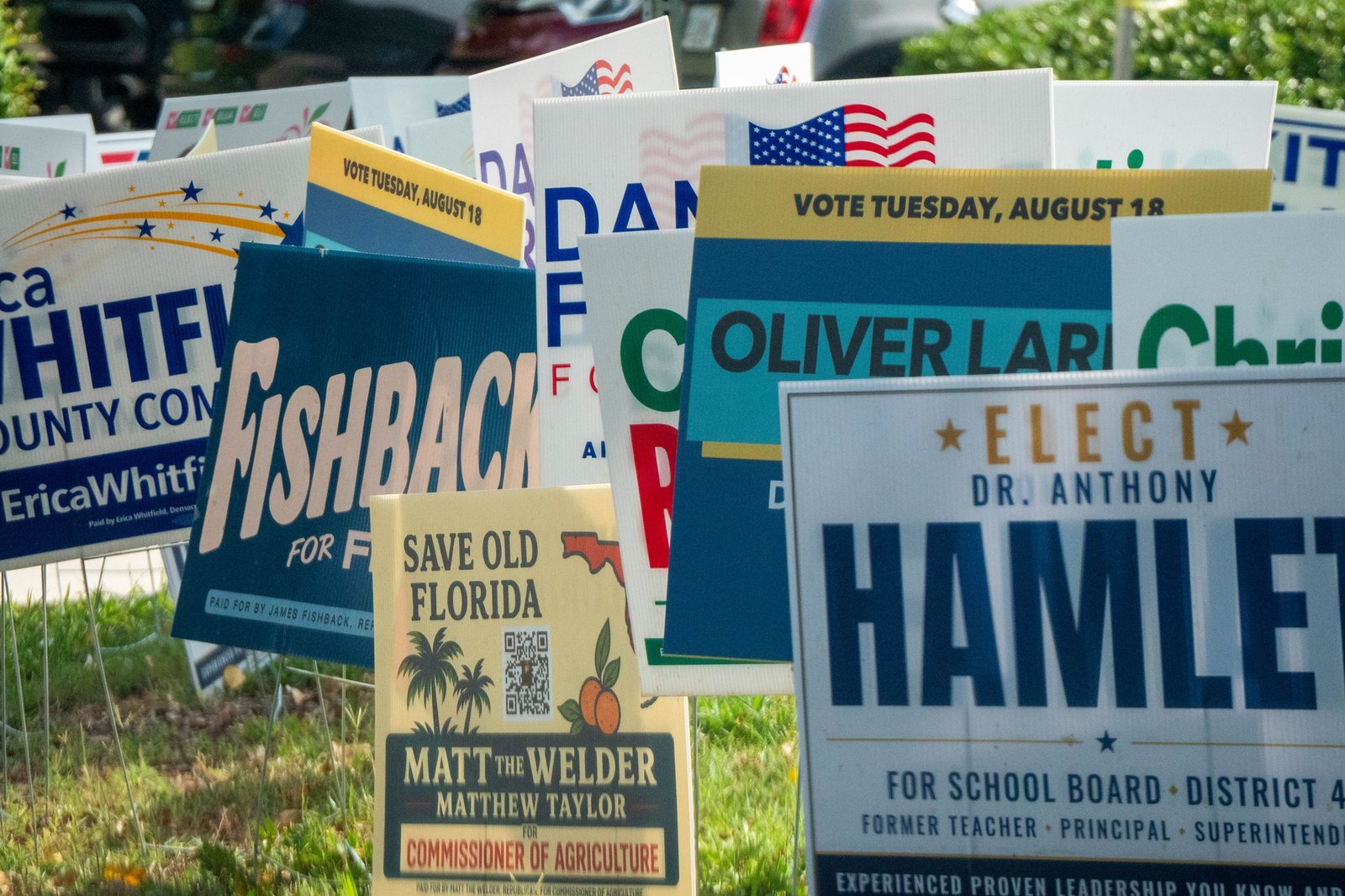
Today is the last major primary day of the year, though “major” is a relative term. Nearly all the action is happening in Florida, against the backdrop of a new congressional map that attempts to deliver four seats to the Republicans, though theoretically Democrats could beat back all four of those challenges. The late changes sent several Democrats scrambling for seats, upending yearlong campaigns and angering constituent groups.
More from David Dayen
The end of the cycle is playing out like the beginning, with big money flooding into districts and a surprising amount of uncertainty over whether it will be successful.
Here’s what we’re watching on the biggest election night left before November:
There will be active campaigns for governor and senator in a state that has gotten so far away from Democrats—it’s almost hard to believe that President Obama won the state twice and the party came within a whisker of winning the governor’s race in 2018—that even a blue-wave year might not make it competitive. Still, Democrats have lined up a well-known resistance figure for Senate and a former GOP congressman for governor. And the ex-Republican appears to be running the more populist campaign.
Sen. Ashley Moody (R-FL) has made a glancing impression since being appointed to replace Marco Rubio. Alexander Vindman, the guy who heard the “perfect phone call” on Ukraine that became the basis for President Trump’s first impeachment, is set to take her on; there’s minor competition from progressive African American state Rep. Angie Nixon, but Vindman has swamped her in the money race. Some polls show a Moody-Vindman race somewhat competitive, but reeling Florida back from MAGA infatuation will take real political talent.
David Jolly may have a better shot. He drifted from Republican to Never Trumper to Democrat and is now modeling the most successful statewide Democrat of the last half-century, Lawton Chiles, who walked the state lengthwise during his successful Senate campaign in 1970. Jolly similarly highlights stories from the campaign trail on his website. More important, likely opponent Rep. Byron Donalds (Gov. Ron DeSantis is term-limited out) has a Trump endorsement but not one from DeSantis; Donalds will likely gain less than a majority in the primary.
The gerrymander approved by DeSantis is highly contingent on whether Latinos in the state will turn out for Republicans in the midterms the same way they turned out for Trump in 2024. That’s probably unlikely; Joe Biden carried two of these Trump districts in 2020. This is why nearly all the Democrats who previously held those seats are defying the gerrymander and running again.
That includes Rep. Darren Soto in FL-09 in the Orlando area (a 58-41 Trump seat in 2024) and Rep. Kathy Castor in FL-14 around Tampa (55-44 Trump). Soto has seven Republicans vying to take him on, including Thomas Chalifoux, whom he defeated under a different map in 2024. There are eight Republicans, including two state representatives, battling to take on Castor.
Rep. Jared Moskowitz opted for the Atlantic Coast seat that is one of the wealthiest in the country (54-45 Trump), but he has to first defeat Oliver Larkin, the DSA-endorsed union organizer. Larkin has called out Moskowitz as a self-described “Ron DeSantis Democrat” (Moskowitz worked for DeSantis at the state emergency management agency, and was rumored as a possible FEMA nominee for Trump) whose donors were contractors for the ill-fated “Alligator Alcatraz” immigration detention camp, which is now closed. Larkin is running a proud campaign, tangling with hosts on Fox News and getting out his ideas on stronger public provision in the economy and ending unconditional aid to Israel.
Larkin has presented an internal poll showing him in a virtual tie in the district, while Moskowitz’s internals have it as a 30-point race. The crosstabs in the Larkin poll show him being blown out among those who already voted while performing well with those who have not; the turnout machine will have to be revved up on tilt for him to pull it off. One potential assist for Larkin is that all the money has come in on the Republican side of this seat, where former Boca Raton mayor Scott Singer and four others are competing. The Republicans have spent $26 million and largely kept Democrats off the air, leveling the playing field a bit.
Analysis that goes beyond the noise with in-depth, progressive reporting.
No paywall, no programmatic ads — just the reporting. Unsubscribe anytime. Submitting your email signs you up for The Daily Prospect, Today on TAP, Aftermath, and Weekend Reads.
Rep. Debbie Wasserman Schultz was the only incumbent to dodge less favorable turf and retreat to a deep-blue seat. It happens to be FL-20, a primarily Black district in Broward County, which has not endeared DWS to the Congressional Black Caucus or the four Black candidates already running there. If anyone can upset her, it’s young progressive Elijah Manley, who appeared at a rally with Nixon and Larkin over the weekend. (That rally had to change venues after a Democratic legislator objected to Rep. Rashida Tlaib’s presence, in yet another indicator of the divide in the party.)
But the fact that the four Black candidates didn’t winnow down to a one-on-one race probably means Wasserman Schultz will win. The field includes former Rep. Sheila Cherfilus-McCormick, who quit this year before being expelled for stealing relief funds and using them to finance her campaign four years ago and is inexplicably attempting a comeback, along with local commissioner Dale Holness and former 2 Live Crew rapper Luther Campbell. Pro Choice Majority Action did get involved late with a $250,000 ad buy for Wasserman Schultz; that PAC’s parent organization has received over $1.5 million from pro-Israel groups.
The seat Wasserman Schultz abandoned, FL-22, was one of the ones Joe Biden won in 2020 before Trump flipped it on the strength of Latino voters. Pia Dandiya, a former Apple executive and first-time candidate, is likely the Democrat here, and the likely Republican opponent Michael Carbonara, a self-funding crypto entrepreneur whose company has faced numerous lawsuits over allegations of financial mismanagement. Why Wasserman Schultz would duck this guy remains a mystery.
The mapmaking gymnastics it took to create four more competitive seats took away strength from three other Republican incumbents who could get beat in a real wave. In FL-12 around Tampa, Rep. Gus Bilirakis will face either Darren McAuley (an Air Force vet) or Kimberly Overman (a local county commissioner). In nearby FL-13, Leela Gray has polling out with her just behind MAGA fave Anna Paulina Luna. And FL-27 in Miami could surprise Rep. Maria Elvira Salazar, a former local TV anchor who could face a Democratic anchor, CBS Miami’s Eliott Rodriguez.
Rep. Cory Mills (R), who has been repeatedly hit with domestic violence and misconduct allegations, could lose his primary in FL-07. Rep. Lois Frankel (D) in the Palm Beach area has a self-funder running to her left but is unlikely to lose.
There’s an open seat in heavily Black FL-24, replacing retiring Rep. Frederica Wilson; Miami-Dade County Commissioner Oliver Gilbert has been attacked by crypto industry–backed Protect Progress PAC in a $2 million ad buy that he believes is coming from backers of Kendrick Meek Jr., whose father, a former House member, is on the advisory board of Coinbase. A third candidate, state Sen. Shevrin Jones, could benefit from the attacks on Gilbert; Save Democracy PAC (a onetime recipient of AIPAC funds) has been among several PACs helping him.
Finally, there’s an absurd race in FL-19, on the Gulf Coast around Naples, where the effort to replace Byron Donalds has attracted the following: a former losing House candidate from Illinois, another former losing House candidate from Illinois, a former congressman from New York who went to jail for insider trading until a Trump pardon, and a former congressman from North Carolina (Madison Cawthorn) who was universally hated and lost his primary after one term.
There’s a special election in a pretty strongly Republican state House seat in Pennsylvania that would be a real coup if Democrat Brandon Dukes could pull it off. Wyoming’s going to get a new senator because HODLer Sen. Cynthia Lummis is leaving to spend more time with her crypto, and the likely winner is Wyoming’s at-large House member, Harriet Hageman.
Alaska has several interesting races in its “top-four” primary. The Senate seat will likely come down to incumbent Sen. Dan Sullivan and former Rep. Mary Peltola, but outside groups are trying to fill those two other slots with fringe candidates who can take away votes from the left and the right. Meanwhile, there’s another Dan Sullivan running; he claims he’s not a Democratic plant but just a guy who hates the other Dan Sullivan. Meanwhile, the governor’s race features the younger brother of former Sen. Mark Begich (a Democrat), former Gov. Bill Walker (an independent), and 12 Republicans. Finally, the at-large seat also has a Begich, the incumbent Rep. Nick Begich III, and his biggest challenge will likely come from Dan Osborn–style independent Bill Hill.
Finally, there’s a special election in the Bay Area of California to replace disgraced Rep. Eric Swalwell in CA-14, and virtually the entire constellation of PACs supporting moderate and pro-Israel Democrats this year have come together to support Melissa Hernandez, even though the last two times she faced progressive state Sen. Aisha Wahab she lost by 20 points or more. Over $5 million has now been spent by supporters of Hernandez. Wahab’s endorsement from the state Democratic Party will probably be as useful to her as it was to victorious Matt Little in a Minnesota House primary last week.
Before you go…
If you believe that this kind of reporting should exist and remain free to read, we hope you’ll consider chipping in. Every contribution, however modest, makes a real difference.
David Dayen
Executive Editor
I hope that you found this article interesting and thought-provoking. The reason we’re able to publish stories like this — free of programmatic ads and never behind a paywall — is because readers like you step up to support our work.
The Prospect doesn’t answer to advertisers or billionaire owners. We answer to you and to our commitment to pursuing the truth, wherever that leads us.
Independent, reader-supported journalism is critical at a time when the free press is under assault.
If you believe this kind of reporting should exist and remain free to read, we hope you’ll consider chipping in. Every contribution, however modest, makes a real difference.
David Dayen
Executive Editor
David Dayen is the executive editor of The American Prospect. He is the author of Monopolized: Life in the Age of Corporate Power and Chain of Title: How Three Ordinary Americans Uncovered Wall Street’s Great Foreclosure Fraud. He co-hosts the podcast Organized Money with Matt Stoller. He can be reached on Signal at ddayen.90. More by David Dayen
Cut through the noise of daily news with in-depth, progressive analysis.
Unsubscribe anytime. Submitting your email signs you up for our daily and weekly newsletters.
Cut through the noise of daily news with in-depth, progressive analysis.
Unsubscribe anytime. Submitting your email signs you up for our daily and weekly newsletters.
Sign in by entering the code we sent to , or clicking the magic link in the email.
Privacy Policy.
We’ll create a new account for .