Now
78°
Wed
95°
Thu
93°
by Eric Weiss, Mike Magnoli
TALLAHASSEE, Fla. (CBS12) — Florida voters head to the polls Tuesday to begin choosing the state’s next governor, with crowded Republican and Democratic fields competing for the nominations to replace term-limited Gov. Ron DeSantis.
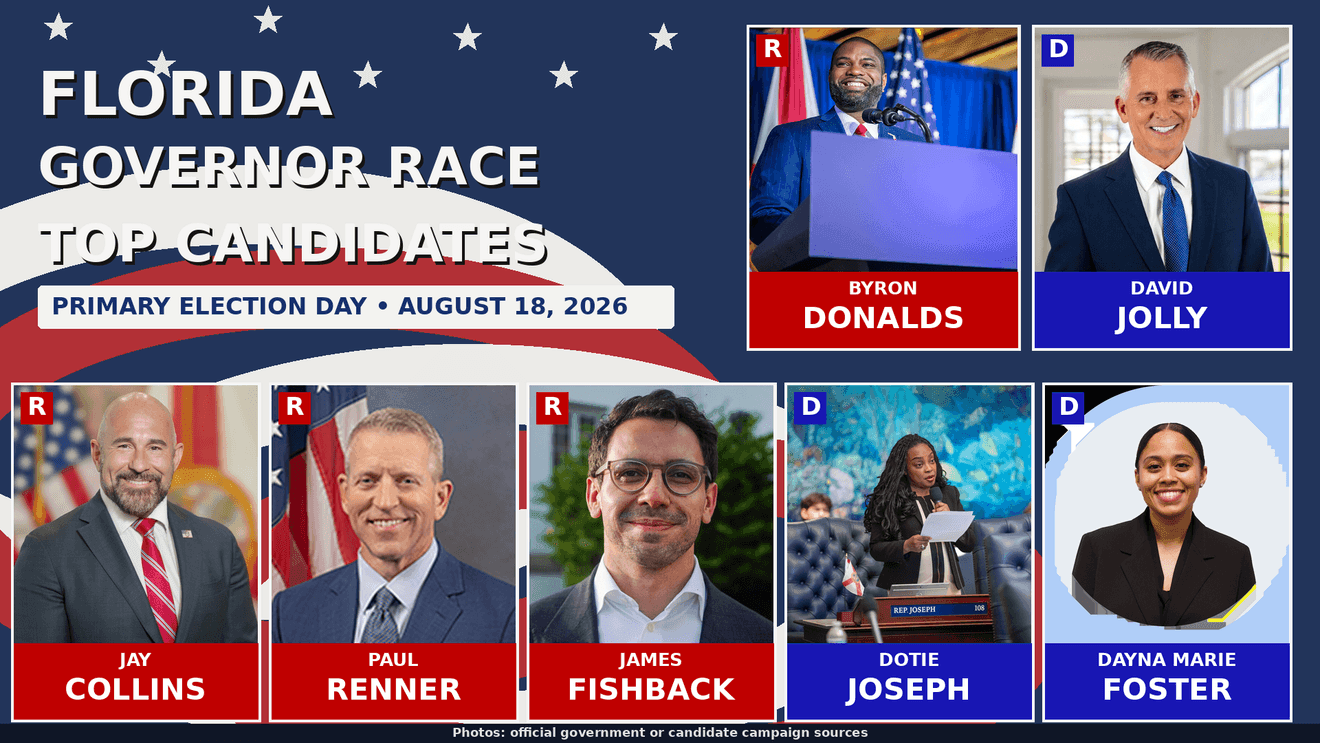
The Aug. 18 primary features 11 Republicans and six Democrats, although polling and fundraising have left two candidates — Republican U.S. Rep. Byron Donalds and Democrat David Jolly — entering Election Day as substantial frontrunners.
Donalds, a Naples-area congressman and former member of the Florida House, has dominated Republican polling after receiving President Donald Trump’s endorsement early in the campaign.
A James Madison Institute poll conducted July 20-26 found Donalds with 49% support among likely Republican primary voters. Lt. Gov. Jay Collins was second at 18%, followed by former Florida House Speaker Paul Renner at 8% and businessman James Fishback at 4%.
Donalds also enters Election Day with a massive financial advantage. The Associated Press reports that he has Trump's endorsement and an overwhelming fundraising edge over the rest of the Republican field. Donalds supported Trump over DeSantis during the 2024 presidential primary, a decision that placed him firmly in Trump's political orbit as the relationship between Trump and DeSantis deteriorated during that campaign.
The Republican race has consequently become, in part, a test of competing political loyalties inside Florida's GOP.
Collins, a former state senator and Army Special Forces veteran, was appointed lieutenant governor by DeSantis in August 2025 and has portrayed himself as a candidate who would preserve the outgoing governor's record. DeSantis, however, has not endorsed a candidate in the primary.
Renner, who served as speaker of the Florida House, and Fishback, a businessman and former investment-firm executive, have also sought to break through against Donalds but have remained well behind him in public polling.
All 11 Republican candidates who qualified for the gubernatorial primary are:
Jay Collins, Byron Donalds, James Fishback, Jim Holcomb, Arthur Joseph McCaffrey, Daniel Nokovich, Paul Renner, Rachel Rodriguez, James W. Shaw, Caneste Succe and Bobby Williams.
The Democratic primary is also crowded, but former U.S. Rep. David Jolly has separated himself from his rivals in fundraising and polling.
Jolly represented the Tampa Bay area in Congress as a Republican before leaving the GOP in 2018. He joined the Democratic Party in 2025 and is now trying to become the first Democrat elected governor of Florida since Lawton Chiles won reelection in 1994.
Jolly has selected former U.S. Rep. Gwen Graham as his running mate. Graham, the daughter of the late Florida governor and U.S. Sen. Bob Graham, unsuccessfully sought the Democratic nomination for governor herself in 2018.
Jolly has made affordability, housing, insurance, education and health care central themes of his campaign, arguing that state government has spent too much time on political and cultural fights while Floridians struggle with the cost of living.
The latest James Madison Institute survey placed Jolly at 47% among likely Democratic primary voters. More than 40% remained undecided, while none of his opponents reached double digits in that poll.
State Rep. Dotie Joseph of Miami and Dayna Marie Foster, a former high school math teacher backed by Florida's Democratic Progressive Caucus, are among Jolly's most visible competitors.
All six Democratic candidates on Tuesday's ballot are:
Evelyn Castillo-Bach, Thomas Eloy Fernandez, Dayna Marie Foster, David Jolly, Dotie Joseph and Stephann Norman.
While 17 candidates are competing in the two major-party primaries, Florida's official candidate list shows 29 qualified candidates for governor overall. The remaining candidates are independents, a Libertarian and write-in candidates who are not competing in Tuesday's Republican or Democratic primaries.
The qualified no-party-affiliation candidates are Dean Ocean Abrams, Charles Burkett, Jeffrey Peter "Dr. Jeff" Datto, Moliere "Moe" Dimanche, Desmond Meade and Frank J. Russo.
Scott Eckhard Jewett, the Libertarian Party of Florida candidate, qualified without primary opposition.
The qualified write-in candidates are Kathy Anderson, David "DJ" DeJesus, Richard Paul Dembinsky, M.W. Khan and Erik Morris.
That means the winners of Tuesday's Republican and Democratic contests will move into a November field considerably larger than a traditional two-party matchup.
Whichever candidates emerge Tuesday will compete in a state whose political landscape has changed dramatically over the past decade.
As of July 20, Florida had about 13.5 million registered voters, including roughly 5.6 million Republicans, 4.1 million Democrats and 3.3 million voters with no party affiliation, according to the Associated Press.
Democrats have not won a Florida gubernatorial election in more than three decades. In 2022, DeSantis defeated Democrat Charlie Crist 59.4% to 40%, a victory that underscored Florida's shift from one of the nation's premier swing states toward Republicans.
Still, the general election may be more competitive than the state's recent results suggest. The July James Madison Institute poll found Donalds leading Jolly 45% to 38% among likely voters in a hypothetical November matchup.
Florida operates a closed primary system. Only voters registered with a political party may vote in that party's primary, meaning Democrats cannot vote in the Republican gubernatorial contest and Republicans cannot vote in the Democratic one. Voters with no party affiliation cannot participate in either partisan gubernatorial primary.
Hundreds of thousands of Floridians have already voted. As of Friday, approximately 663,000 Republican ballots and 610,000 Democratic ballots had been cast ahead of Election Day.
Polls close at 7 p.m. local time Tuesday. That means polls close at 7 p.m. Eastern across most of Florida and at 8 p.m. Eastern in counties located in the Central Time Zone.
By Tuesday night, Florida voters should have a much clearer picture of whether the race to succeed DeSantis becomes the Donalds-versus-Jolly contest that polling has forecast — or whether one of the 15 other major-party candidates can deliver an Election Day surprise.
2026 Sinclair, Inc.