Published
Oct 07, 2026 at 03:26 PM EDT
Reporter
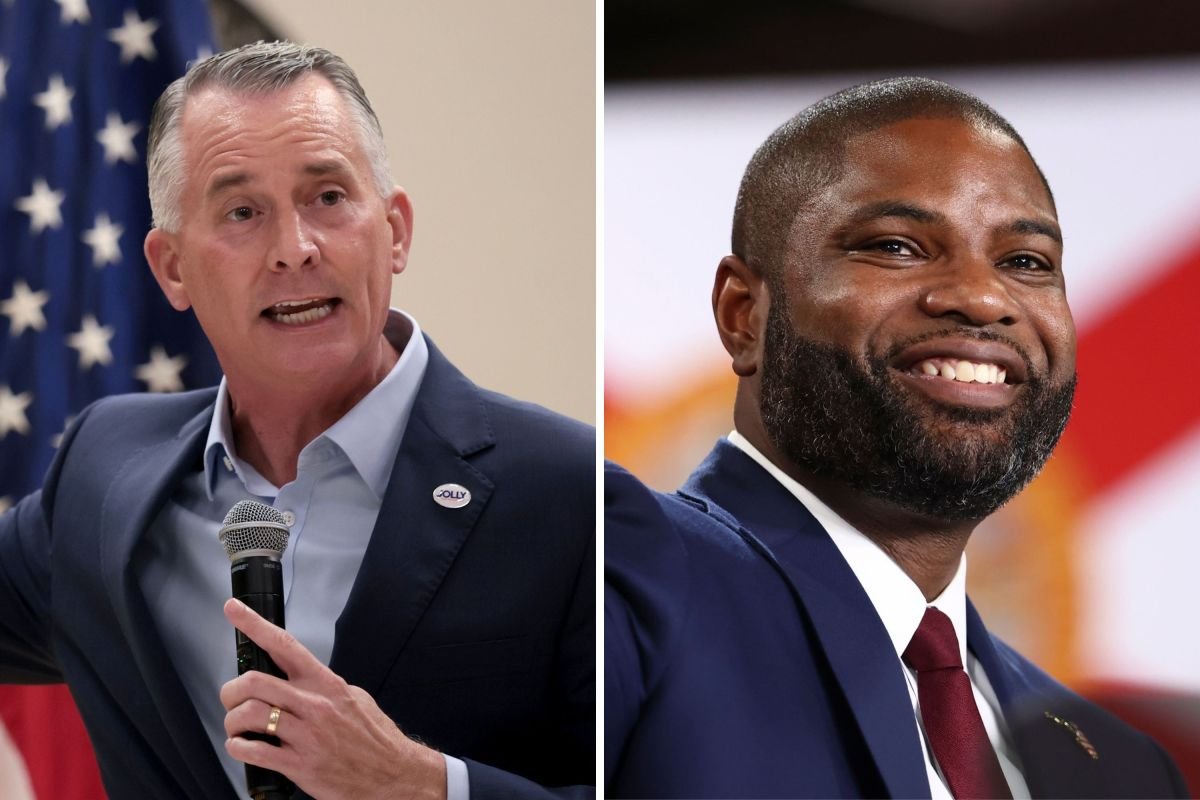
Democrat David Jolly is trailing Republican Representative Byron Donalds by just 2 points in the race for Florida governor, according to a new YouGov poll, the latest sign that the contest to succeed Governor Ron DeSantis is tighter than many expected.
The survey of 3,813 likely voters, conducted September 28 to October 5, found Donalds at 47 percent and Jolly at 45 percent, with 7 percent undecided. The gap falls within the poll’s margin of error of plus or minus 2.7 percentage points. Newsweek reached out to both campaigns via email for comment.
Florida has not elected a Democratic governor since Lawton Chiles won reelection in 1994, and Republicans have spent the past decade turning the onetime battleground into one of their most dependable states. President Donald Trump, who moved his legal residence from New York to his Mar-a-Lago estate in Palm Beach during his first term, carried Florida by about 13 points in 2024.
A close race for Trump’s pick in his own home state would say a good deal about how much the national mood has moved before the November 3 midterms.
The YouGov sample leans Republican by registration, 45 percent to 31 percent, and respondents said they backed Trump over Kamala Harris by 11 points in 2024. Even so, 54 percent of likely voters said they disapprove of the job Trump is doing as president, including 49 percent who strongly disapprove. Forty-six percent approve.
Jolly’s support is concentrated among younger voters. He leads Donalds 59 percent to 28 percent among voters ages 18 to 29 and 54 percent to 35 percent among those 30 to 44. Donalds leads 55 percent to 40 percent among voters 65 and older, who make up 39 percent of the poll’s likely electorate.
The poll also found Jolly ahead among Hispanic voters, 49 percent to 44 percent, a group that swung sharply toward Republicans in DeSantis’ 2022 reelection and Trump’s 2024 win. Donalds leads white voters without a college degree 59 percent to 33 percent, while white college graduates are nearly split, 47 percent for Donalds and 45 percent for Jolly.
There is little crossover voting, and what exists favors the Democrat: 5 percent of Trump’s 2024 voters back Jolly, against 1 percent of Harris voters who back Donalds.
The broader picture is less settled. Some recent surveys show Jolly narrowly ahead, while others give Donalds a high single-digit or double-digit lead. Forecasters have steadily moved the race toward Democrats, but prediction markets still treat Donalds as a clear favorite.
The other newest survey in the race came from Mason-Dixon Polling & Strategy. Its poll for NBC 6 Miami and Telemundo, taken September 28 to October 1 among 625 likely voters, had Donalds up 7 points, 48 percent to 41 percent.
Two Change Research polls have pointed the other way. A survey for Freedom Project USA, conducted September 25 to 27, showed Jolly leading 48 percent to 46 percent, and an earlier September poll from the firm had him up 47 percent to 44 percent. A Hart Research survey for the Democratic Governors Association, released in late August, put Jolly at 46 percent and Donalds at 45 percent.
Stetson University’s Center for Public Opinion Research has the widest recent gap: Donalds 51 percent, Jolly 39 percent, in a survey taken September 14 to 21. The University of North Florida’s July poll was tighter, with Donalds ahead 46 percent to 41 percent.
Florida’s recent history offers a caution for Democrats reading those numbers. In 2018, final polling averages showed Democrat Andrew Gillum ahead of DeSantis by several points, but DeSantis won by less than half a percentage point. In 2022, polls showed DeSantis leading Charlie Crist, another former Republican running as a Democrat, by low double digits, and he won by more than 19 points.
Election forecasters have nonetheless shifted their ratings. The Cook Political Report moved the race from “Solid Republican” to “Likely Republican” in late August. Sabato’s Crystal Ball, which rated the race “Safe Republican” until July, now has it at “Lean Republican.” Decision Desk HQ went furthest, moving Florida from “Lean Republican” to “Toss-up.”
“Cook is saying the contest is no longer a complete lock,” Craig Agranoff, a political professor at Florida Atlantic University, told Newsweek after the shift, “mainly because David Jolly is a former Republican with a ticket that can talk to independents.”
Florida decided the 2000 presidential election by 537 votes and remained a perennial swing state through 2016. That changed quickly.
Republicans overtook Democrats in voter registration in 2021, and the gap has since widened. As of June 30, the state had about 5.57 million registered Republicans, 4.04 million Democrats and 3.32 million voters with no party affiliation, according to the Florida Division of Elections.
DeSantis’ 2022 landslide, which included carrying heavily Hispanic Miami-Dade County, turned him into a national figure and briefly a rival to Trump for the party’s 2024 nomination. Trump then won the state by double digits.
Florida Republicans now hold every statewide office, and the state has become a pipeline for the administration: former Senator Marco Rubio left his seat to become secretary of state, and DeSantis appointed then-Attorney General Ashley Moody to replace him.
The tension between Trump and DeSantis also shaped this year’s primary. Trump endorsed Donalds early, while DeSantis stood behind Lieutenant Governor Jay Collins. Donalds won the August 18 primary with 47.8 percent of the vote.
Donalds’ campaign says it has raised more than $90 million, a financial edge that Jolly has not come close to matching.
Ryan Smith, the campaign’s chief strategist, dismissed the Sabato move in July. “Florida is a red state and will remain a red state in November when Byron Donalds is elected the next Governor,” he said.
Democrats point to recent special elections as evidence that the state’s rightward drift has stalled. In March, first-time candidate Emily Gregory flipped Florida House District 87, which includes Mar-a-Lago, defeating Trump-endorsed Republican Jon Maples. A Republican had carried the district by 19 points in 2024. Donalds had filmed an endorsement for Maples.
Jolly, a former Republican congressman from Pinellas County who left the party during Trump’s first term, has built his campaign around affordability, housing costs and opposition to new data centers. His running mate is former Democratic Representative Gwen Graham.
“For the first time, the Florida governor’s race is officially a toss up,” Jolly wrote on social media after the Decision Desk HQ move. “Florida is winnable.”
“In this change election, Florida is ready to elect a Democrat,” Mark Riddle, a senior adviser to Jolly, said in a statement.
Donalds’ camp has shrugged off the ratings changes. After the Cook move, communications director Gates McGavick posted “Nice try, guys” on X and said the campaign looked forward “to checking in with @CookPolitical on November 4th.”
Florida’s Senate race, a special election for the remainder of Rubio’s term, looks somewhat less competitive. The YouGov poll found Moody leading Democrat Angie Nixon 49 percent to 44 percent, with 5 percent undecided after allocation. Both candidates’ supporters appear locked in: 95 percent of Nixon voters and 94 percent of Moody voters said their minds are made up.
Nixon, a state representative from Jacksonville and self-described democratic socialist, won the August primary with about 55 percent of the vote, defeating retired Army Lieutenant Colonel Alexander Vindman despite being outspent by roughly $17 million.
Since the primary, the numbers have been all over the place. St. Pete Polls, surveying for Florida Politics, had Moody at 45.2 percent and Nixon at 44.8 percent. Change Research’s poll for Freedom Project USA put Moody ahead by a single point, 48 to 47. Quantus Insights gave her a 7-point lead, and the July UNF survey had her up 8.
Nixon has attacked Moody over a grand jury report that named the senator in a plan to steer $10 million from a Medicaid settlement to the Hope Florida Foundation, a nonprofit created by Florida first lady Casey DeSantis. Nixon called for Moody’s resignation after the report’s release.
Moody remains a heavy favorite in prediction markets, which gave her a better than 90 percent chance of winning in late August. No Democrat has won a Senate race in Florida since Bill Nelson in 2012.
Early voting begins later this month, and the election is November 3.
© 2026 Newsweek Digital LLC
David Jolly Within Striking Distance of Byron Donalds: Florida Poll – Newsweek