For months, Florida Gov. Ron DeSantis pushed hard for a constitutional amendment that would drastically change the state’s property tax system. The GOP-led state Legislature went along, passing a proposal that will appear on the Nov. 3 ballot.
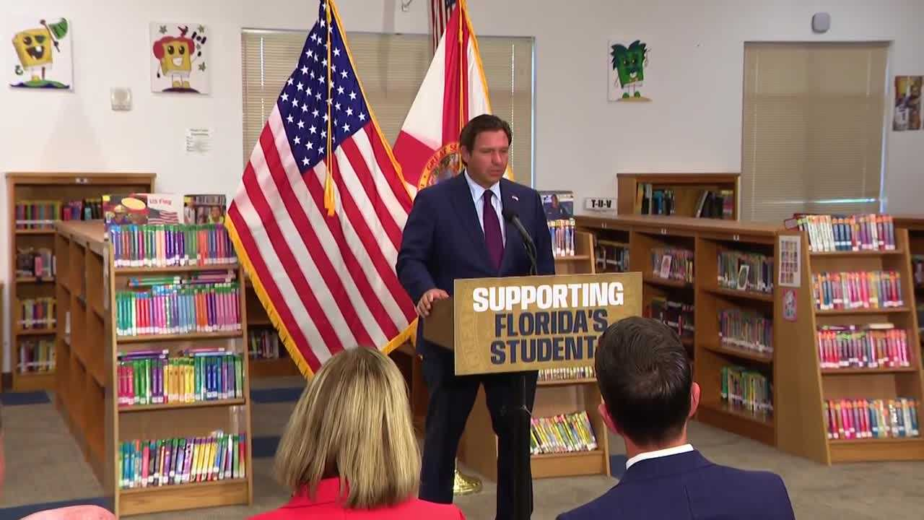
But unlike his high-profile campaigns that successfully defeated amendments legalizing recreational marijuana and boosting abortion rights, DeSantis isn’t taking a lead role on the tax amendment.
Without DeSantis in the bully pulpit and organized opposition growing, it’s like the property tax amendment is out on an island alone.
“Measures typically perform better when there’s a campaign to support them,” said Craig Burnett, political science chair at Florida Atlantic University. “Not having elected officials support the measure does make it something of an orphan.”
There are prominent politicians in favor of the property tax amendment, including Republican gubernatorial frontrunner Byron Donalds, GOP Sen. Rick Scott and many others. But none are leading a campaign for it.
DeSantis has said repeatedly that although he will vote for the amendment, he’s taking a back seat rather than campaign for it because it differs in several ways from his original idea.
“If someone asked me to do something, I’m not saying I wouldn’t, but in terms of leading the effort, in terms of me saying, ‘Here we go, we’re going to do this, we’re going to do all that.’ You know, I’m not going to do it,” DeSantis said at a June 29 event in Tampa.
If at least 60% of voters approve of Nov. 3, the amendment would raise the property tax homestead exemption — the discount for a person’s main residence — from $50,000 currently to $150,000 in 2027 and $250,000 the year after that. Property taxes that funding schools, however, would not be affected.
Still, over two years the change would cost Florida county and municipal governments nearly $12 billion, according to state estimates. That has prompted many local government groups, including the Florida Sheriffs Association, to express concern or outright opposition to the amendment.
Polk County Sheriff Grady Judd, a Republican and former president of the sheriffs association, said state lawmakers failed to consider the crippling costs to local governments when approving the proposal.
“They have no idea the devastation of Amendment 3 in its current form will be to cities and counties,” Judd said. “When you get to some small counties, it will wipe them out.”
The proposed amendment already hit a road bump when Leon County Circuit Judge David Frank ruled Aug. 3 that the ballot language was defective and biased, reading more like a batch of political slogans than a clear description of its impact.
“It is not fair or neutral. It advocates a policy position: to stop excessive property taxes,” Frank said in his order, specifically citing the amendment’s title: Save Our Homes From Excessive Property Taxes.
“The purpose of a ballot summary is to explain what an amendment would do, not to advocate for its adoption,” the judge added.
However, the amendment will remain on the November ballot after Attorney General James Uthmeier came up with a rewritten summary that is more neutral. The new title is “Increased Homestead Exemption; Lower Cap on Increases in Non-Homesteaded Property Assessments.”
Donalds, the Republican running to succeed the term-limited DeSantis, has voiced strong support for the amendment and that if it fails, if elected he will ask a state commission next year to recommend a complete property tax overhaul. If it passes, Donalds will ask state lawmakers to create a funding mechanism to help smaller counties survive.
“We’re in this situation where the people of Florida need relief,” Donalds said in a recent television appearance. “So that’s what we’re going to inherit.”
A recent University of North Florida Public Opinion Research Lab poll found that support for the amendment dropped sharply if voters are told about its impact on local government services, with 47% opposed in that scenario and 45% strongly or somewhat in support. That’s far short of the 60% threshold for passage.
“Given this, we think the passage of Amendment 3 is highly unlikely,” said Sean Freeder, director of the UNF research lab. “The ballot language issue is compounded by problems with generating support among coalitions.”
FAU’s Burnett agreed. “If you forced me to pick, I’d probably lean toward it failing because there isn’t much political support for it.”
One avenue DeSantis could have used was foreclosed by the state Legislature. After the governor used at least $35 million in public dollars in 2024 to defeat the marijuana and abortion amendments, lawmakers passed a measure barring use of taxpayer money to advocate for or against constitution amendments. DeSantis signed it into law.
DeSantis said he’d be a more forceful campaigner if lawmakers had approved his original proposal.
“What the Legislature did wasn’t my proposal. We had a proposal and I felt an obligation if that were on the ballot to lead the effort,” the governor said in June. “And I wouldn’t have liked doing it, but I would have felt an obligation.”
Aside from those objections, DeSantis hasn’t ruled out a future run for office following his failed campaign for president in 2024. That, Freeder said, could be part of the reason he’s on the sidelines on property taxes.
“At the end of two terms, those in executive office start seriously thinking about legacy and, had DeSantis vigorously supported it, any major budget shortfall issues in the future would also probably be negatively tied to said legacy,” Freeder said. “If he doesn’t get involved, even if it were to pass, his hands remain mostly clean.”
Curt Anderson is the Policy and Politics Reporter for The USA TODAY NETWORK-FLORIDA. You can get all of Florida’s best content directly in your inbox each weekday day by signing up for the free newsletter, Florida TODAY athttps://tallahassee.com/newsletters.
Property tax plan was DeSantis' idea, so why isn't he campaigning for it? – Tallahassee Democrat